
Our Gifts to Children

November 27, 2023

The brain of a young child works differently than the brain of an adult. Sensorial experiences shape children’s brains, forming neurological webs that last throughout their life. 


The fact that our interactions with young people help shape their future selves opens up an incredible opportunity. Each experience can be a gift. Often the simplest moments can carry the most meaning.


During the rush of this season, we have the opportunity to slow down and really be present with the young children in our lives. By being open to the wonder and delight our children experience, we gain new perspective while also giving the best gift of all: our total attention. 


This may mean taking a deep breath and momentarily turning off the chatter of the to-do list, squatting down to a child’s eye level, smiling, and just listening or seeing what they want to share. A helpful holiday mantra can be: Talk less. Listen more.


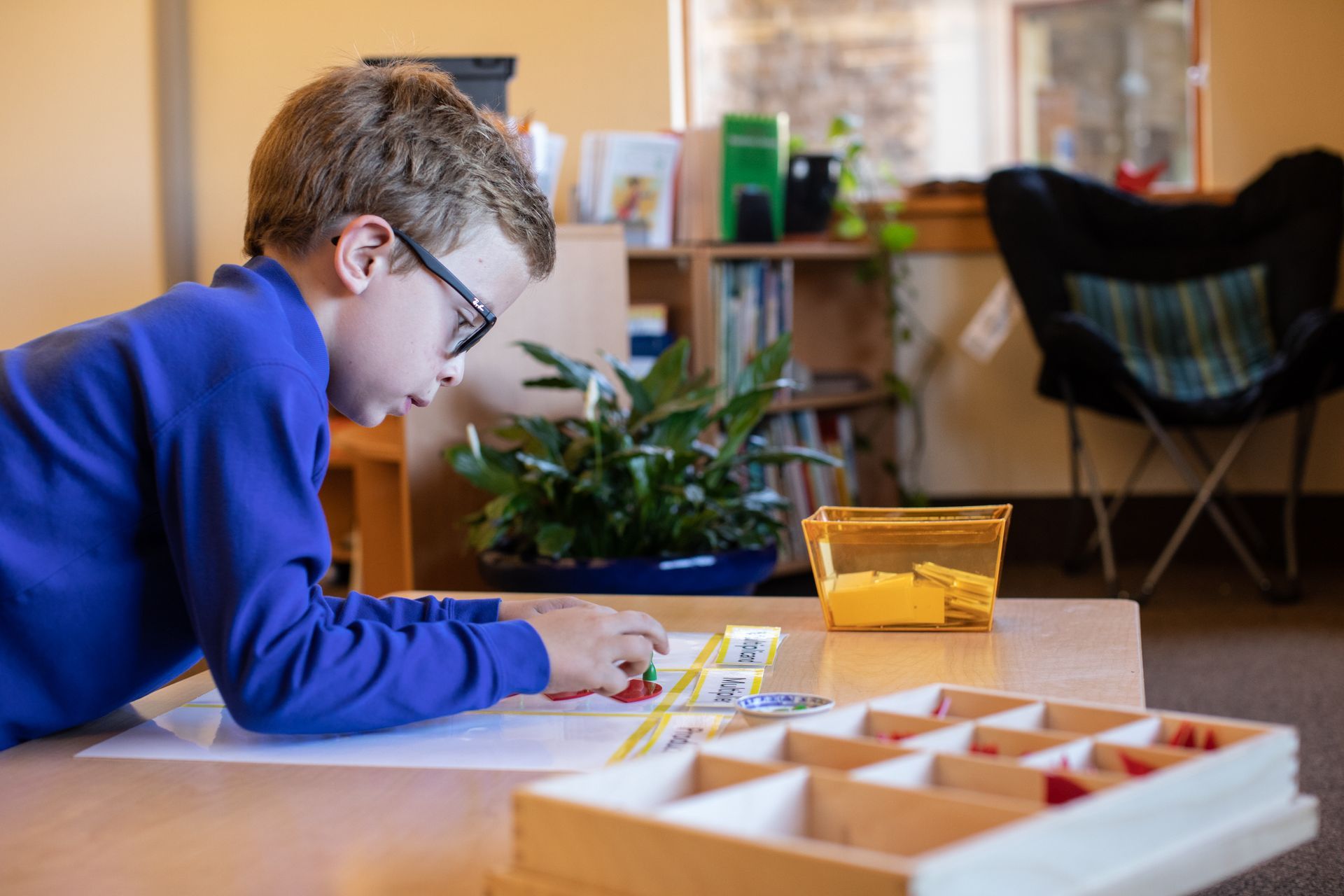
In addition to giving our full attention, whether for 20 seconds or 20 minutes, we can also offer to teach a young person a new skill. The key to these teaching moments is to focus on each distinct step so the skill is simple and attainable. Even very young children can be involved with tasks like setting the table, wrapping gifts, and tending to simple household maintenance. They appreciate being involved with routine activities and they want to contribute in a meaningful way.


Dr. Jane Healy, author of numerous books, including Your Child’s Growing Mind, reminds us that children need the opportunity to repeatedly practice activities that seem second nature to adults: “Self-help skills and household jobs are very important for the child to master–help your child, but encourage him to do it himself even if the job isn’t done exactly your way!”


When encouraging or supporting a child in trying a new skill or participating in a new task, be sure to take the child’s perspective into account. Showing how to do something is often the most effective and verbalized instructions can be kept to a minimum. In fact, it is best to not talk while showing something and to not show something while talking! This allows the child to focus on absorbing one kind of sensory input, thus keeping the information clear in their mind. 


These kinds of ordered and clear experiences are key to a child’s development. “Impressions do not merely enter his mind; they form it,” explained Dr. Maria Montessori a physician turned educator who spent intensive time observing children, making scientific notes, and thus coming to an enlightened understanding of childhood development.


Dr. Montessori observed how children respond positively to organization, both in terms of expected routines and physical space. Current research, such as that comparing the HOME inventory (Home Observation for Measurement of the Environment) to longitudinal information collected in the Bayley Mental Development Inventory, shows that organized environments lead to higher intelligence scores.* 


We all know that the holiday season throws our routines and even our physical settings a bit askew. With this in mind, children benefit greatly from adults in their lives maintaining a calm sense of order during this busy time. 


In order to create a calm, ordered environment, we ourselves need to have balance and clarity in our own lives! Staying present in the moment, breathing deeply, and ultimately taking care of our own needs allows us to offer our best selves to the children around us. 


What we offer to our children, in terms of our presence, special activities, or toys, can provide opportunities to aid their development. During this time of gift-giving, for example, we can provide objects that have an intelligent purpose and help children contribute in a meaningful way to the order around them. Child-sized, yet real, items are particularly valuable: cooking tools, building tools, yard tools, and even mops and brooms. 


Children don’t stay young for long, and the early years are extremely formative. In her book, Understanding the Human Being: The Importance of the First Three Years of Life, Silvana Quattrocchi Montanaro explains the significance of a young child’s experiences: “Everything that comes from the environment is received, processed and stored in the brain cells with no effort using a form of unconscious absorption. This intense mental activity is always going on, even in prenatal life, and it characterizes ‘the absorbent mind’.” 


For those interested in learning more about optimal environments for these “absorbent minds,” schedule a visit to our school. We can share more about setting up home environments that best support child development and show how our learning environments are specifically designed for neurological growth.


Knowing that the young children around us are absorbing everything about their surroundings, this season let’s give them our attention, meaningful ways to contribute to daily tasks, and a calm, ordered environment. As a result, we’re helping some remarkable young people as they develop into capable, caring young adults.


*For more information on this research, check out the book, Montessori: The Science Behind the Genius by Angeline Stoll Lillard.


You might also like

Child exploring outdoor Montessori environment with hands-on activity
May 4, 2026
Discover how Montessori education nurtures children's deepest human needs — from exploration and meaningful work to belonging and spiritual growth.
April 27, 2026
In Part One of this series, we began exploring the eight Montessori principles that Dr. Angeline Stoll Lillard examines in her landmark book, Montessori: The Science Behind the Genius . As we saw, what makes these principles so compelling is that Dr. Maria Montessori's intuitions about children were a precursor to what decades of developmental science have since confirmed about how humans actually learn. In this second and final installment, we pick up where we left off, examining the remaining principles and the research that brings them to life. Whether you're a parent, an educator, or simply someone curious about what effective learning really looks like, these insights offer a fascinating window into the remarkable alignment between one woman's careful observations over a century ago and the science we have today. If you haven’t already, be sure to check out the previous four principles: Movement and Learning Are Deeply Entwined Choice Improves Both Learning and Well-Being Children Learn Best When They're Genuinely Interested Rewards Undermine the Motivation They're Meant to Build PRINCIPLE FIVE: Children Learn Powerfully from Each Other When you walk into a Montessori classroom, you’ll notice that children are almost always working near or directly with other children. Peer learning is one of the most effective forms of learning, and Montessori classrooms are deliberately structured to make it a constant. Much of this learning happens through observation. When a child watches a slightly older classmate work through challenging material, they're absorbing the technique and the possibility. They begin to see what they can do! Peer observation often drives a spontaneous "explosion" of writing or number awareness, spreading through a class (e.g., one child suddenly writing everywhere, then several more following). The mixed-age grouping in Montessori classrooms amplifies this. Younger children always have a visible horizon of what's coming next. Older children consolidate their own understanding by helping younger ones (which is one of the most effective learning strategies known). And the large, stable class community means children have time to build genuine relationships and observe one another across many contexts over several years. PRINCIPLE SIX: Meaningful Context Makes Learning Richer and More Lasting Children remember far more when what they're learning is connected to something real and purposeful. What the Research Shows In one study, three-year-olds were asked to memorize lists of items. When the lists were presented as shopping lists for a pretend store, the children remembered twice as many items as those who were simply told to memorize a list. Montessori education is built on this principle. Practical life activities such as cooking, cleaning, caring for plants and animals teach children that the skills they are learning connect to the real world. The Montessori curriculum is deliberately integrated. Vocabulary develops alongside sensorial exploration. Math concepts are entwined with concrete materials that make abstract ideas visible. Knowledge in one area consistently links to knowledge in others. This is why Montessori materials are not isolated exercises but part of a spiral curriculum that returns to the same ideas with greater depth and complexity as children grow. PRINCIPLE SEVEN: How Adults Interact with Children Shapes Everything The way an adult responds to a child's efforts has effects that ripple far beyond the moment. What the Research Shows Carol Dweck's research, now widely cited, demonstrated that a single sentence of feedback can set children on divergent trajectories. Children told "you must be smart" after succeeding at a problem later chose easier tasks, enjoyed them less, and performed worse after encountering difficulty. Children told "you must have worked hard" sought harder challenges, recovered from failure more readily, and improved their performance over time. The difference is in the delivery of one sentence! The implications are profound for how we talk to children about both their successes and their struggles. In a Montessori classroom, the adult’s role is carefully defined: to observe, to connect children to materials at the right moment, to step back when a child is productively engaged, and to step in only when something is genuinely unproductive or unsafe. This requires a great deal of precision and restraint. An adult who constantly intervenes, corrects, and directs trains children to look outward for approval. An adult who observes and offers at the right moment helps children learn to look inward. Consistency and long-term relationships also matter. The multi-age grouping in Montessori means that children spend multiple years with the same adults, building the kind of attachment and trust that research consistently links to stronger learning outcomes and healthier social-emotional development. PRINCIPLE EIGHT: Order in the Environment Supports Order in the Mind The Montessori classroom's distinctive aesthetic reflects a deep understanding of how the environment shapes cognition. What the Research Shows Research consistently shows that noise, clutter, and unpredictability are cognitively costly for children. When an environment is chaotic, children spend precious mental energy managing uncertainty rather than engaging in learning. Temporal order matters as much as spatial order. The three-hour uninterrupted work cycle (a hallmark of Montessori classrooms) gives children long enough stretches of focused time to move from initial engagement to deep concentration and, eventually, to the kind of absorbed flow that produces real intellectual development. Frequent interruptions (bells, transitions, whole-class pivots) train children to work in short bursts and to constantly reorient. The three-hour cycle allows children to go deep. Children in Montessori classrooms are also responsible for maintaining their environment by returning materials to their proper place, caring for plants and classroom spaces, and treating everything with consideration. This care builds the child's relationship to order as something they participate in creating rather than something imposed from the outside. Even noise levels matter in ways that go beyond comfort. What the Research Shows Research cited by Dr. Lillard found that across all ages, noise was one of the most consistently negative influences on cognitive development, partly because it interferes with the auditory discrimination that underpins both reading and vocabulary development. The quiet that characterizes a well-functioning Montessori classroom is the natural result of many children deeply absorbed in their own work. What makes Dr. Lillard’s work so valuable because it validates the Montessori method and gives the why behind practices that can otherwise seem puzzling from the outside. There are important reasons why Montessori teachers don't correct every error, why there are no gold stars, why the classroom is so quiet, and why children seem to do the same work over and over. This approach to education is deeply rooted in creating conditions in which children's natural drive to learn can develop as fully as possible! To learn more, visit our school here in Milwaukee. And let us know if you would like to borrow a copy of Montessori: The Science Behind the Genius by Dr. Angeline Stoll Lillard! It is one of the most research-grounded books available on Montessori education, and we highly recommend it for anyone who wants to understand the deeper logic of Montessori!
Two children collaborating with practical life activity in Montessori classroom
April 20, 2026
Does Montessori work? Explore the research behind movement, choice, interest, and intrinsic motivation in Montessori: The Science Behind the Genius.
More Posts