Elementary Story: How Geometry Got Its Name
January 26, 2026

In Montessori elementary classrooms, we like to introduce big ideas with big stories. We offer children a sense of wonder first, sort of like an imaginative doorway, so that when they later study formulas, theorems, and proofs, they already feel connected to the human story behind them.


One of these stories is The Story of How Geometry Got Its Name, an introduction to a subject that is far older than the textbooks and protractors we encounter today. In Montessori, Geometry is more than about shapes. It is about human beings solving real problems in the real world.


A Problem as Old as Civilization


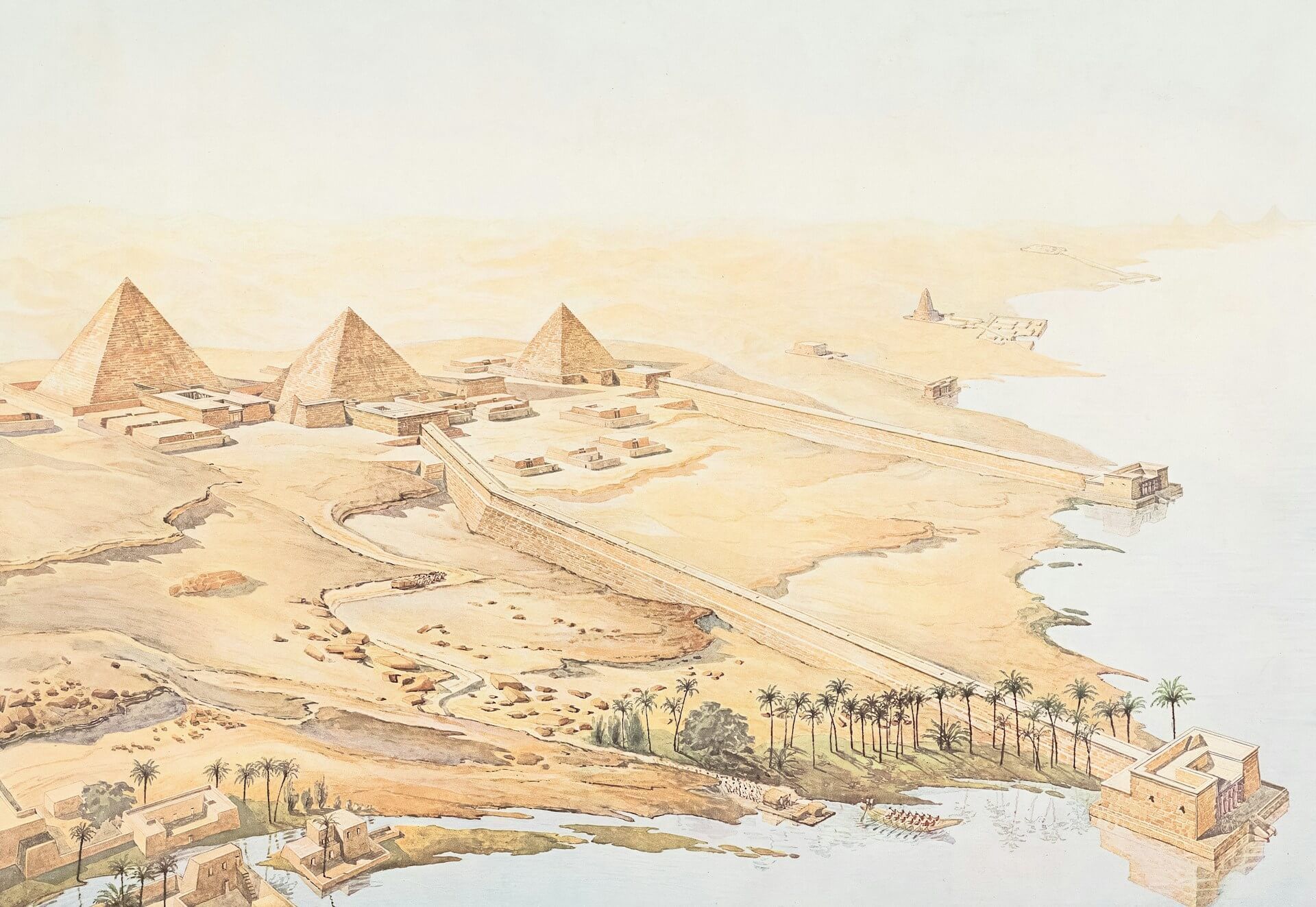
To introduce geometry, we take children about five thousand years back in time to the ancient civilization of Egypt. This was a land shaped by the , the longest river in the world. Each year, the Nile flooded its banks as snowmelt poured down from the mountains far to the south. The Egyptians depended on this yearly flood as it left behind rich, dark silt that nourished their crops and made life possible in an otherwise harsh desert.


But the flood created a challenge, too. It washed away the boundary markers that separated one farmer’s field from another. When the waters receded, no one could quite remember where their land began and ended. Arguments ensued. “This corner is mine!” And the fields needed to be measured and marked again.


The First Geometers: The Rope Stretchers


To solve this annual problem, the Egyptians relied on a special group of skilled workers called the Harpedonaptai, or Rope Stretchers. These were early land surveyors who used a knotted rope tied at regular intervals and three weights to create a very particular triangle.


In the classroom, we invite a few children to hold a prepared rope at its large knots, forming that same triangle. As they stretch it out and lay it on the ground, many quickly recognize what the Egyptians had unknowingly created: a scalene right-angled triangle. This shape would later become central to the geometry studied by Greek mathematicians.


The Rope Stretchers used this simple tool to re-establish field boundaries, set right angles, and make sure the land was measured accurately and fairly. Geometry, in its earliest form, served a deeply practical purpose.


From Rope to Pyramid


The Rope Stretchers’ expertise was valued far beyond the farmlands. They also helped lay out the foundations of temples, monuments, and even the Great Pyramid of Giza. The base of the Great Pyramid is a perfect square, which is an astonishing feat of measurement and design. The Pharaoh himself oversaw these measurements, but it was the Rope Stretchers who executed them.


Their work represents one of humanity’s earliest recorded sciences: the careful measuring of the earth.


How Geometry Got Its Name


The name geometry reflects this ancient practice. It comes from two Greek words:


— earth

metron — measure


Geometry literally means earth measurement.


The Egyptians did not use the language of right angles, nor did they classify triangles as we do today. Their work was grounded in practical needs. They needed to solve problems, organize land, and create structures that would endure for thousands of years. Yet their discoveries influenced later thinkers like Pythagoras, who likely traveled to Egypt and learned from their methods. Over time, the simple knotted rope inspired a whole discipline devoted to understanding lines, angles, shapes, and the relationships between them.


Why We Tell This Story in Montessori


When Montessori children hear this story, something important happens. Geometry becomes more than a set of rules or vocabulary words. It becomes a human endeavor born from curiosity, necessity, and ingenuity.


This is the heart of Montessori’s cosmic education: helping children see knowledge not as isolated subjects, but as gifts from generations before them. When children pick up a ruler, explore angles with a protractor, or classify triangles in the classroom, they are continuing a legacy that began with those early Rope Stretchers on the banks of the Nile.


Through story, children feel connected to the people who shaped our world and to the problems that inspired great ideas. Schedule a tour today to see how geometry becomes meaningful, purposeful, and alive for our children here in Milwaukee.

You might also like

Child exploring outdoor Montessori environment with hands-on activity
May 4, 2026
Discover how Montessori education nurtures children's deepest human needs — from exploration and meaningful work to belonging and spiritual growth.
April 27, 2026
In Part One of this series, we began exploring the eight Montessori principles that Dr. Angeline Stoll Lillard examines in her landmark book, Montessori: The Science Behind the Genius . As we saw, what makes these principles so compelling is that Dr. Maria Montessori's intuitions about children were a precursor to what decades of developmental science have since confirmed about how humans actually learn. In this second and final installment, we pick up where we left off, examining the remaining principles and the research that brings them to life. Whether you're a parent, an educator, or simply someone curious about what effective learning really looks like, these insights offer a fascinating window into the remarkable alignment between one woman's careful observations over a century ago and the science we have today. If you haven’t already, be sure to check out the previous four principles: Movement and Learning Are Deeply Entwined Choice Improves Both Learning and Well-Being Children Learn Best When They're Genuinely Interested Rewards Undermine the Motivation They're Meant to Build PRINCIPLE FIVE: Children Learn Powerfully from Each Other When you walk into a Montessori classroom, you’ll notice that children are almost always working near or directly with other children. Peer learning is one of the most effective forms of learning, and Montessori classrooms are deliberately structured to make it a constant. Much of this learning happens through observation. When a child watches a slightly older classmate work through challenging material, they're absorbing the technique and the possibility. They begin to see what they can do! Peer observation often drives a spontaneous "explosion" of writing or number awareness, spreading through a class (e.g., one child suddenly writing everywhere, then several more following). The mixed-age grouping in Montessori classrooms amplifies this. Younger children always have a visible horizon of what's coming next. Older children consolidate their own understanding by helping younger ones (which is one of the most effective learning strategies known). And the large, stable class community means children have time to build genuine relationships and observe one another across many contexts over several years. PRINCIPLE SIX: Meaningful Context Makes Learning Richer and More Lasting Children remember far more when what they're learning is connected to something real and purposeful. What the Research Shows In one study, three-year-olds were asked to memorize lists of items. When the lists were presented as shopping lists for a pretend store, the children remembered twice as many items as those who were simply told to memorize a list. Montessori education is built on this principle. Practical life activities such as cooking, cleaning, caring for plants and animals teach children that the skills they are learning connect to the real world. The Montessori curriculum is deliberately integrated. Vocabulary develops alongside sensorial exploration. Math concepts are entwined with concrete materials that make abstract ideas visible. Knowledge in one area consistently links to knowledge in others. This is why Montessori materials are not isolated exercises but part of a spiral curriculum that returns to the same ideas with greater depth and complexity as children grow. PRINCIPLE SEVEN: How Adults Interact with Children Shapes Everything The way an adult responds to a child's efforts has effects that ripple far beyond the moment. What the Research Shows Carol Dweck's research, now widely cited, demonstrated that a single sentence of feedback can set children on divergent trajectories. Children told "you must be smart" after succeeding at a problem later chose easier tasks, enjoyed them less, and performed worse after encountering difficulty. Children told "you must have worked hard" sought harder challenges, recovered from failure more readily, and improved their performance over time. The difference is in the delivery of one sentence! The implications are profound for how we talk to children about both their successes and their struggles. In a Montessori classroom, the adult’s role is carefully defined: to observe, to connect children to materials at the right moment, to step back when a child is productively engaged, and to step in only when something is genuinely unproductive or unsafe. This requires a great deal of precision and restraint. An adult who constantly intervenes, corrects, and directs trains children to look outward for approval. An adult who observes and offers at the right moment helps children learn to look inward. Consistency and long-term relationships also matter. The multi-age grouping in Montessori means that children spend multiple years with the same adults, building the kind of attachment and trust that research consistently links to stronger learning outcomes and healthier social-emotional development. PRINCIPLE EIGHT: Order in the Environment Supports Order in the Mind The Montessori classroom's distinctive aesthetic reflects a deep understanding of how the environment shapes cognition. What the Research Shows Research consistently shows that noise, clutter, and unpredictability are cognitively costly for children. When an environment is chaotic, children spend precious mental energy managing uncertainty rather than engaging in learning. Temporal order matters as much as spatial order. The three-hour uninterrupted work cycle (a hallmark of Montessori classrooms) gives children long enough stretches of focused time to move from initial engagement to deep concentration and, eventually, to the kind of absorbed flow that produces real intellectual development. Frequent interruptions (bells, transitions, whole-class pivots) train children to work in short bursts and to constantly reorient. The three-hour cycle allows children to go deep. Children in Montessori classrooms are also responsible for maintaining their environment by returning materials to their proper place, caring for plants and classroom spaces, and treating everything with consideration. This care builds the child's relationship to order as something they participate in creating rather than something imposed from the outside. Even noise levels matter in ways that go beyond comfort. What the Research Shows Research cited by Dr. Lillard found that across all ages, noise was one of the most consistently negative influences on cognitive development, partly because it interferes with the auditory discrimination that underpins both reading and vocabulary development. The quiet that characterizes a well-functioning Montessori classroom is the natural result of many children deeply absorbed in their own work. What makes Dr. Lillard’s work so valuable because it validates the Montessori method and gives the why behind practices that can otherwise seem puzzling from the outside. There are important reasons why Montessori teachers don't correct every error, why there are no gold stars, why the classroom is so quiet, and why children seem to do the same work over and over. This approach to education is deeply rooted in creating conditions in which children's natural drive to learn can develop as fully as possible! To learn more, visit our school here in Milwaukee. And let us know if you would like to borrow a copy of Montessori: The Science Behind the Genius by Dr. Angeline Stoll Lillard! It is one of the most research-grounded books available on Montessori education, and we highly recommend it for anyone who wants to understand the deeper logic of Montessori!
Two children collaborating with practical life activity in Montessori classroom
April 20, 2026
Does Montessori work? Explore the research behind movement, choice, interest, and intrinsic motivation in Montessori: The Science Behind the Genius.
More Posts