What is Cosmic Education?

Tracy T • March 22, 2021

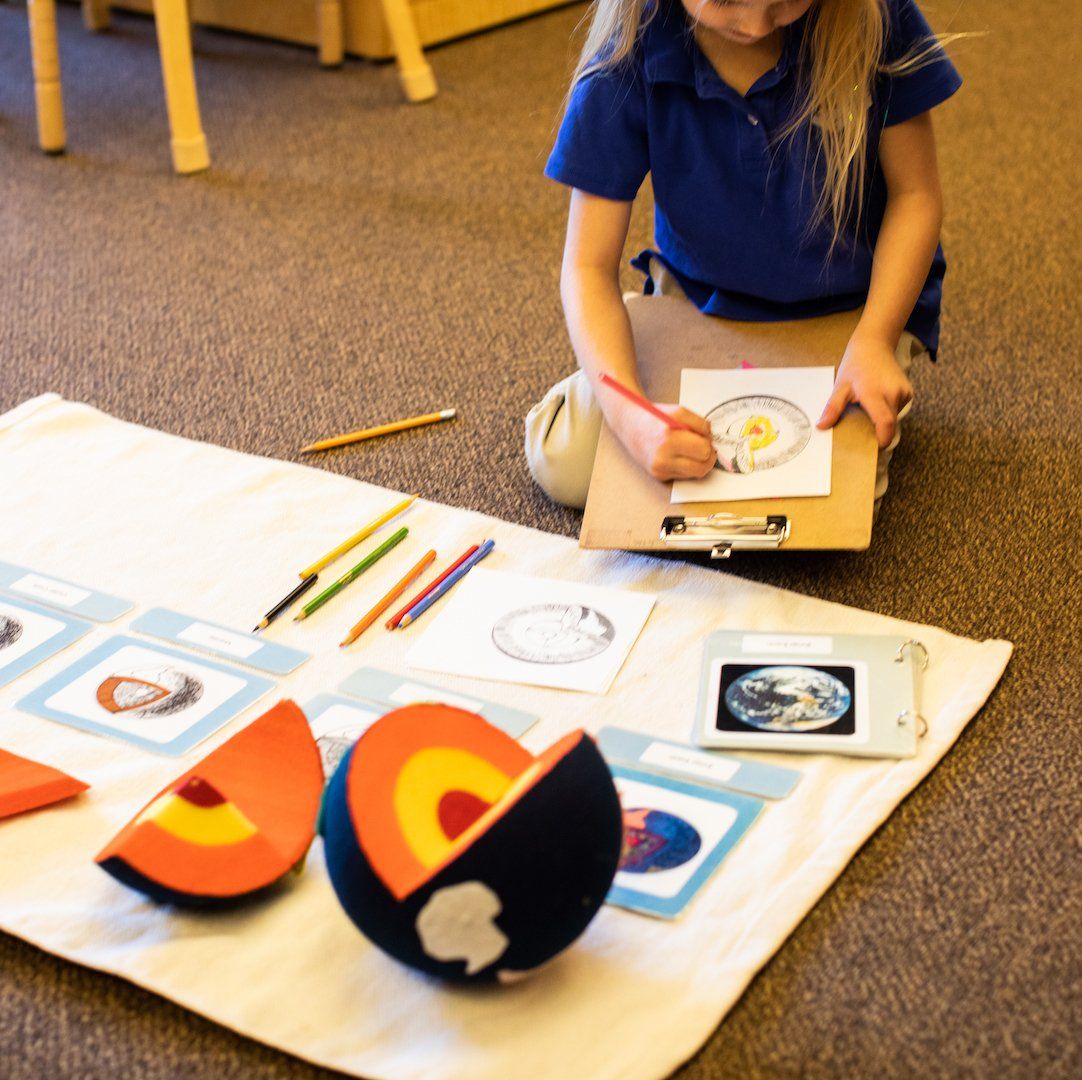
As your child nears the end of their early childhood years and edges toward elementary, you may begin hearing the term cosmic education. Ever wonder what Montessori folks are referring to when they say this? The short answer is that cosmic education is the term Maria Montessori gave to the elementary cultural curriculum (and by cultural, we mean history, science, and geography).

As you may have guessed, to truly understand cosmic education, it takes much more than a short answer. Read on to learn more!

Hallmark Traits of the Second Plane

Before we explain what cosmic education is, it will help if we explain why it was developed in the first place. As you know, Montessori education relies heavily on our knowledge of the developmental characteristics of children. As children grow and change, so should our approaches in how we serve their educational needs. Montessori organizes the stages of development into four planes, and children ages 6-12 fall within the second plane of development. Some of the most notable characteristics of children this age include:

  • A shift from concrete learning and understanding to more abstract concepts
  • A strong sense of justice and fairness
  • A desire to cultivate social relationships with peers
  • A tendency toward imagination
  • A deep interest in the world around them
  • A need for work that feels big and important

Montessori education takes these unique characteristics into account with the way we approach our work with children in both lower and upper elementary. We allow for more social work experiences, we give plentiful opportunities for cultural learning, and even the lessons and materials were created to appeal to the needs of school-aged children.

A Deeper Definition
When we think about cosmic education, we think about our aims to give children a bigger picture of the world, their place in it, and the interconnectedness of everything. It is during this time they begin seeking answers to questions related to these topics, and their desire to learn as much about the world as possible is satisfied by the large amount of information available in their classroom environments.

Each year during the elementary years begins with a study of the beginnings of the universe. From here, and throughout the year, the study trickles outward. Children may learn about our solar system, basic chemistry, or how science experiments are conducted.

They learn about the evolution of life on earth, as well as in-depth unit studies in botany and zoology. There are opportunities for research (independent and alongside peers), presentations, and exploration.

The children learn about our ancient human ancestors, the civilizations of centuries past, and the origins of writing and mathematics. The latter are perfectly timed, considering elementary children are in the process of discovering reading, writing, and math for themselves.

Impactful Lessons and Materials
Have you heard of the Montessori Great Lessons? These five impressionistic lessons are considered the springboard into cosmic education. They are theatrical and make quite an impact on children. They are presented in a storytelling fashion, which appeals to children’s imagination, yet they are rooted in facts, which appeals to their desire to learn the truth.

Each of these five lessons is given repeatedly throughout a child’s years in elementary, and each time they receive a lesson they will glean something new from it, and the follow-up studies may be different as well.

1. The Beginning of the Universe
The first great lesson is dramatic and exciting. Students enter a darkened room with soft music playing. After they are seated, the guide begins telling the story of when everything was darker and colder than they can imagine, and how a great flaring forth was the beginning of our universe. There are moments in the lesson when they are shown grains of sand in comparison to the number of stars, they learn about the attraction and repelling of particles, how weight and density affects matter, and what the three states of matter are on earth.

Following this storytelling lesson, the class will launch into a different, related unit of study each year, giving children the ability to see things from a different perspective.

Before the second great lesson, students are able to interact with a number of materials that put the vastness of time in perspective. The Clock of Eons reimagines Earth’s history and major periods of time on a 12-hour clock. The Long Black Strip illustrates how much time passed with an actual long black strip of fabric, before reaching a tiny section of white at the end, signifying human’s history on the planet.

2. The Coming of Life on Earth
Children love learning about animals, so this particular work is always approached with great enthusiasm. The main material used is called the Timeline of Life, and it colorfully and beautifully illustrates the evolution of life on our planet from the early Paleozoic Era through today. Being able to see how life has changed over time, and even the ways in which it has remained the same, always makes an impact on children.

This work naturally lends itself to in-depth studies of both plants and animals, with various methods of classification.

3. The Study of Early Humans
Touched upon in lower elementary, but often emphasized in upper elementary, there is a timeline to support this study as well. We are all fascinated to learn about our ancestors, and it gives children a sense of gratitude for those that have come before us and for all the great work that has been done throughout history.

Not only do children have an opportunity to study early hominids, but as mentioned earlier they take a look at the early great civilizations and how they changed over time.

4. The History of Writing
From the earliest cuneiform, hieroglyphs, and ancient scripts, to the various languages written around the world today, the history of writing is fascinating. To learn about such information while also learning to write for the first time in one’s life sparks a curiosity that is difficult to replicate.

5. The History of Mathematics
Math is a subject that grows in sequential building blocks, and so it was with the discoveries of various mathematical concepts. Over time, humans discovered more complex and abstract ways of expressing the numerical world. Just as with learning about the beginnings of writing, children are always excited to learn about how math has evolved throughout time and in various cultures.

Now that you have a basic understanding of cosmic education, we would love to hear what you think. Curious to learn more? The best way is to see it for yourself. Call us today to schedule a visit.

You might also like
Teacher guiding children working together at table in Montessori classroom
May 11, 2026
See how Montessori timelines make abstract time tangible for children, building historical thinking, imagination, and inner order through hands-on work.
Child exploring outdoor Montessori environment with hands-on activity
May 4, 2026
Discover how Montessori education nurtures children's deepest human needs — from exploration and meaningful work to belonging and spiritual growth.
April 27, 2026
In Part One of this series, we began exploring the eight Montessori principles that Dr. Angeline Stoll Lillard examines in her landmark book, Montessori: The Science Behind the Genius . As we saw, what makes these principles so compelling is that Dr. Maria Montessori's intuitions about children were a precursor to what decades of developmental science have since confirmed about how humans actually learn. In this second and final installment, we pick up where we left off, examining the remaining principles and the research that brings them to life. Whether you're a parent, an educator, or simply someone curious about what effective learning really looks like, these insights offer a fascinating window into the remarkable alignment between one woman's careful observations over a century ago and the science we have today. If you haven’t already, be sure to check out the previous four principles: Movement and Learning Are Deeply Entwined Choice Improves Both Learning and Well-Being Children Learn Best When They're Genuinely Interested Rewards Undermine the Motivation They're Meant to Build PRINCIPLE FIVE: Children Learn Powerfully from Each Other When you walk into a Montessori classroom, you’ll notice that children are almost always working near or directly with other children. Peer learning is one of the most effective forms of learning, and Montessori classrooms are deliberately structured to make it a constant. Much of this learning happens through observation. When a child watches a slightly older classmate work through challenging material, they're absorbing the technique and the possibility. They begin to see what they can do! Peer observation often drives a spontaneous "explosion" of writing or number awareness, spreading through a class (e.g., one child suddenly writing everywhere, then several more following). The mixed-age grouping in Montessori classrooms amplifies this. Younger children always have a visible horizon of what's coming next. Older children consolidate their own understanding by helping younger ones (which is one of the most effective learning strategies known). And the large, stable class community means children have time to build genuine relationships and observe one another across many contexts over several years. PRINCIPLE SIX: Meaningful Context Makes Learning Richer and More Lasting Children remember far more when what they're learning is connected to something real and purposeful. What the Research Shows In one study, three-year-olds were asked to memorize lists of items. When the lists were presented as shopping lists for a pretend store, the children remembered twice as many items as those who were simply told to memorize a list. Montessori education is built on this principle. Practical life activities such as cooking, cleaning, caring for plants and animals teach children that the skills they are learning connect to the real world. The Montessori curriculum is deliberately integrated. Vocabulary develops alongside sensorial exploration. Math concepts are entwined with concrete materials that make abstract ideas visible. Knowledge in one area consistently links to knowledge in others. This is why Montessori materials are not isolated exercises but part of a spiral curriculum that returns to the same ideas with greater depth and complexity as children grow. PRINCIPLE SEVEN: How Adults Interact with Children Shapes Everything The way an adult responds to a child's efforts has effects that ripple far beyond the moment. What the Research Shows Carol Dweck's research, now widely cited, demonstrated that a single sentence of feedback can set children on divergent trajectories. Children told "you must be smart" after succeeding at a problem later chose easier tasks, enjoyed them less, and performed worse after encountering difficulty. Children told "you must have worked hard" sought harder challenges, recovered from failure more readily, and improved their performance over time. The difference is in the delivery of one sentence! The implications are profound for how we talk to children about both their successes and their struggles. In a Montessori classroom, the adult’s role is carefully defined: to observe, to connect children to materials at the right moment, to step back when a child is productively engaged, and to step in only when something is genuinely unproductive or unsafe. This requires a great deal of precision and restraint. An adult who constantly intervenes, corrects, and directs trains children to look outward for approval. An adult who observes and offers at the right moment helps children learn to look inward. Consistency and long-term relationships also matter. The multi-age grouping in Montessori means that children spend multiple years with the same adults, building the kind of attachment and trust that research consistently links to stronger learning outcomes and healthier social-emotional development. PRINCIPLE EIGHT: Order in the Environment Supports Order in the Mind The Montessori classroom's distinctive aesthetic reflects a deep understanding of how the environment shapes cognition. What the Research Shows Research consistently shows that noise, clutter, and unpredictability are cognitively costly for children. When an environment is chaotic, children spend precious mental energy managing uncertainty rather than engaging in learning. Temporal order matters as much as spatial order. The three-hour uninterrupted work cycle (a hallmark of Montessori classrooms) gives children long enough stretches of focused time to move from initial engagement to deep concentration and, eventually, to the kind of absorbed flow that produces real intellectual development. Frequent interruptions (bells, transitions, whole-class pivots) train children to work in short bursts and to constantly reorient. The three-hour cycle allows children to go deep. Children in Montessori classrooms are also responsible for maintaining their environment by returning materials to their proper place, caring for plants and classroom spaces, and treating everything with consideration. This care builds the child's relationship to order as something they participate in creating rather than something imposed from the outside. Even noise levels matter in ways that go beyond comfort. What the Research Shows Research cited by Dr. Lillard found that across all ages, noise was one of the most consistently negative influences on cognitive development, partly because it interferes with the auditory discrimination that underpins both reading and vocabulary development. The quiet that characterizes a well-functioning Montessori classroom is the natural result of many children deeply absorbed in their own work. What makes Dr. Lillard’s work so valuable because it validates the Montessori method and gives the why behind practices that can otherwise seem puzzling from the outside. There are important reasons why Montessori teachers don't correct every error, why there are no gold stars, why the classroom is so quiet, and why children seem to do the same work over and over. This approach to education is deeply rooted in creating conditions in which children's natural drive to learn can develop as fully as possible! To learn more, visit our school here in Milwaukee. And let us know if you would like to borrow a copy of Montessori: The Science Behind the Genius by Dr. Angeline Stoll Lillard! It is one of the most research-grounded books available on Montessori education, and we highly recommend it for anyone who wants to understand the deeper logic of Montessori!
More Posts