Small Handles, Big Discoveries: Inside the Montessori Geometry Cabinet
Nestled on a low shelf in our Primary and Elementary prepared environments at North Shore Montessori School, you’ll find a beautiful wooden cabinet housing six or seven slim drawers. To an untrained eye, it might look like a simple piece of classroom furniture.
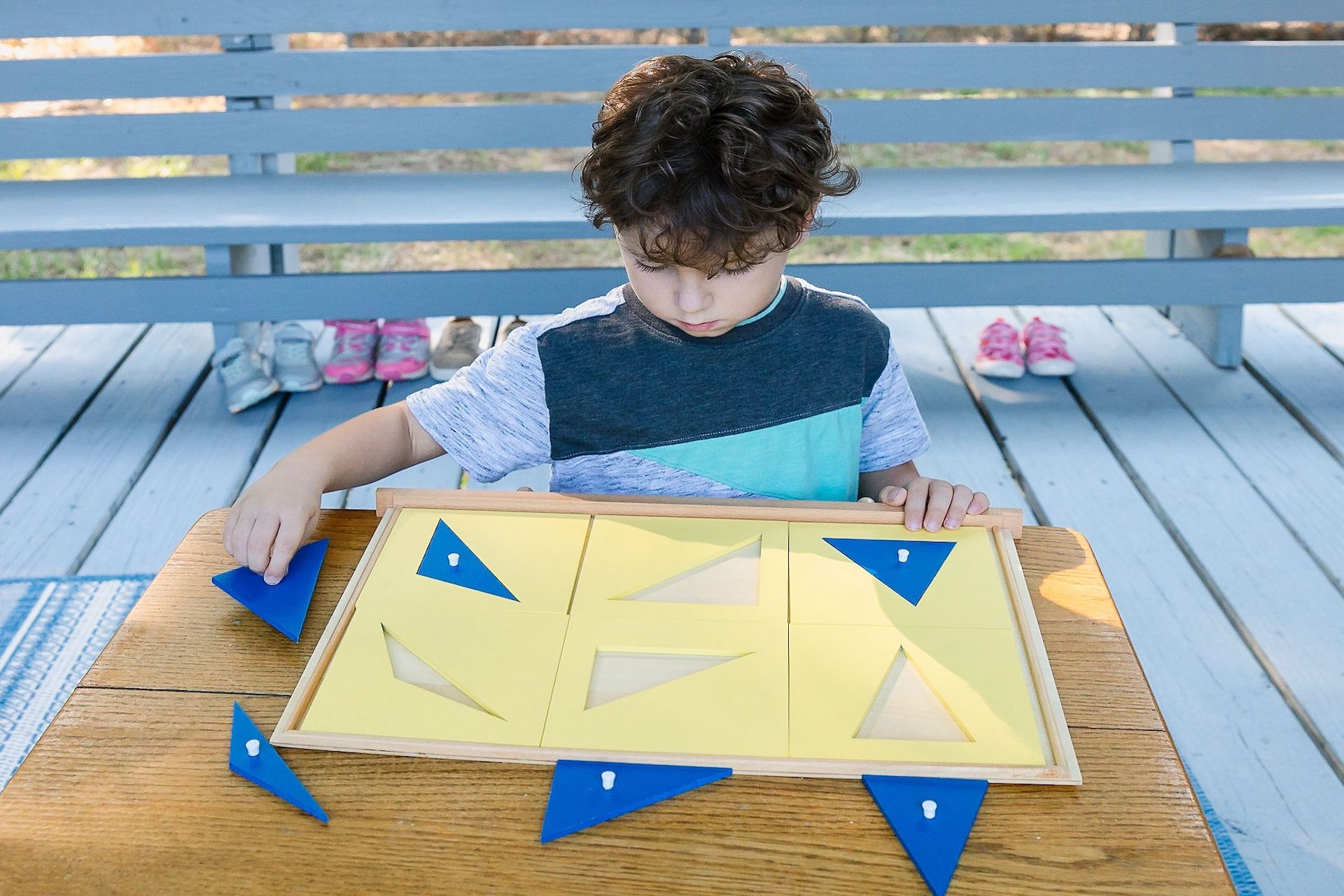
Slide open one of the drawers, however, and you’ll discover a carefully organized set of wooden insets fitted into smooth square frames. Each inset features a small wooden knob in its center and represents a precise geometric figure: circles varying in diameter, rectangles shifting in width, diverse triangles, regular polygons, quadrilaterals, and curved figures.
This is the Geometry Cabinet—a foundational Montessori material designed to refine visual discrimination, strengthen fine motor control for writing, expand mathematical vocabulary, and introduce plane geometry in a concrete, tactile way.
The Foundation for Geometry and Spatial Reasoning
At the top of the cabinet sits the demonstration tray, featuring three fundamental shapes: the equilateral triangle, the square, and the circle. In geometry, these three figures form the starting point for complex spatial concepts:
- The circle connects to measuring angles and rotational symmetry.
- The triangle serves as the construction unit for all other polygons.
- The square provides the foundation for measuring area.
In the Primary classroom, guides use this tray to introduce the mechanics of the material—how to lift the insets, trace their perimeters, and return them carefully to their frames. In the Elementary years, children build on this foundation to explore advanced concepts, such as how a circle can be understood as a polygon with an infinite number of sides.
A Tactile and Sensorial Experience
Montessori education grounds abstract ideas in physical experience. When a child works with the Geometry Cabinet:
- They lift the shape using its central knob with their non-dominant hand.
- They carefully trace the outer perimeter of the inset using the index and middle fingers of their dominant hand.
- They trace the inner border of the matching frame before fitting the piece back into place.
This calm, deliberate movement provides a clear tactile impression of each shape's edges and angles while developing the finger strength and coordination needed for handwriting. As children master single drawers, they progress to mixing shapes from multiple drawers and eventually matching shapes while wearing a blindfold—relying entirely on their tactile memory and fine motor precision.
Moving from Concrete Shapes to Abstract Symbols
To bridge concrete objects and abstract concepts, children work with three sets of geometry cards for each shape:
- Set 1: A solid-colored shape filling the card.
- Set 2: A thick line outline (1 cm wide).
- Set 3: A thin line outline (1 mm wide).
The child matches the wooden inset to the solid shape first, then moves through the progress of thin outlines.
This sequence systematically teaches the child that a flat line drawing can represent a three-dimensional, physical object. Recognizing the subtle distinction between an isosceles trapezoid and a parallelogram directly prepares the child's brain to distinguish between similar abstract letter forms, such as a lowercase b and a d.
Rich, Precise Language
In a Montessori environment, we introduce exact terminology without simplifying the language. Young children absorb vocabulary naturally when paired with physical materials.
Through the Geometry Cabinet, children learn to identify and name specific figures with confidence:
- Quadrilaterals: Rhombus, parallelogram, trapezoid, square, rectangle.
- Curved Figures: Oval, ellipse, quatrefoil, circle.
- Triangles: Acute-angled scalene, obtuse-angled isosceles, right-angled scalene, and equilateral.
- Polygons: Pentagon, hexagon, heptagon, octagon, nonagon, decagon.
Rather than grouping every three-sided figure under the general label of "triangle," children learn to classify shapes by their side lengths and interior angles through hands-on discovery.
Sensorial Games and Memory Work
Once a child understands the shapes, guides introduce memory games that test recognition and deepen concentration:
- Distance Matching: Shapes and frames are placed on opposite sides of the room. The child carries the visual impression of a shape in their memory across the classroom to find its match.
- Environmental Matching: Children search the classroom environment to find real-world objects that match the geometric shapes in the cabinet.
- Gradation Challenges: Children work collaboratively to arrange a set of shapes—such as six circles of increasing diameter—in exact order, sometimes relying on touch alone with the shapes behind their backs.
Experience the Geometry Cabinet at North Shore Montessori School
The Geometry Cabinet demonstrates how a single, beautifully crafted material supports physical refinement, language acquisition, handwriting preparation, and mathematical understanding.
We invite families to visit North Shore Montessori School to observe our prepared environments and see how materials like the Geometry Cabinet support long-term learning and independence. Schedule a tour with our admissions team today.
You might also like