150 Years: The Mixed-Age Classroom

Tracy T • February 1, 2021

This article is part of a series that we will share throughout the 2020-2021 school year to celebrate the 150th birthday of Dr. Maria Montessori. Check back often for more posts that reflect on the past, present, and future of Montessori education

There are many elements that make Montessori education stand apart from more conventional methods. One of the most obvious is our mixed-age classrooms. Rather than grouping children by a single chronological age, our classroom environments encompass children spanning across several ages.

We find this method to be a huge benefit. Read on to learn more.

But…why?

There are so many perks to having mixed-age classrooms. Some of the key points include:

  • Models and leaders

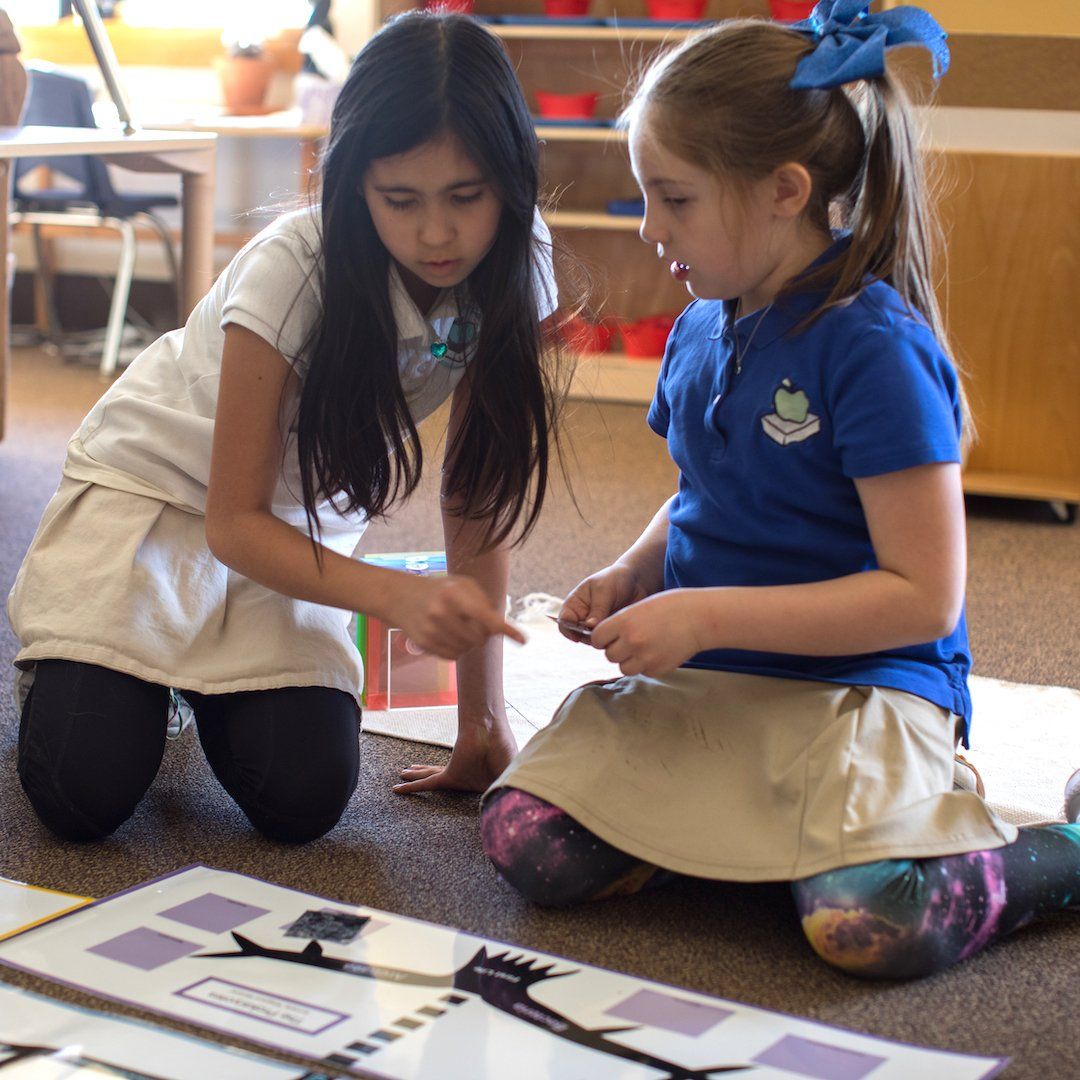
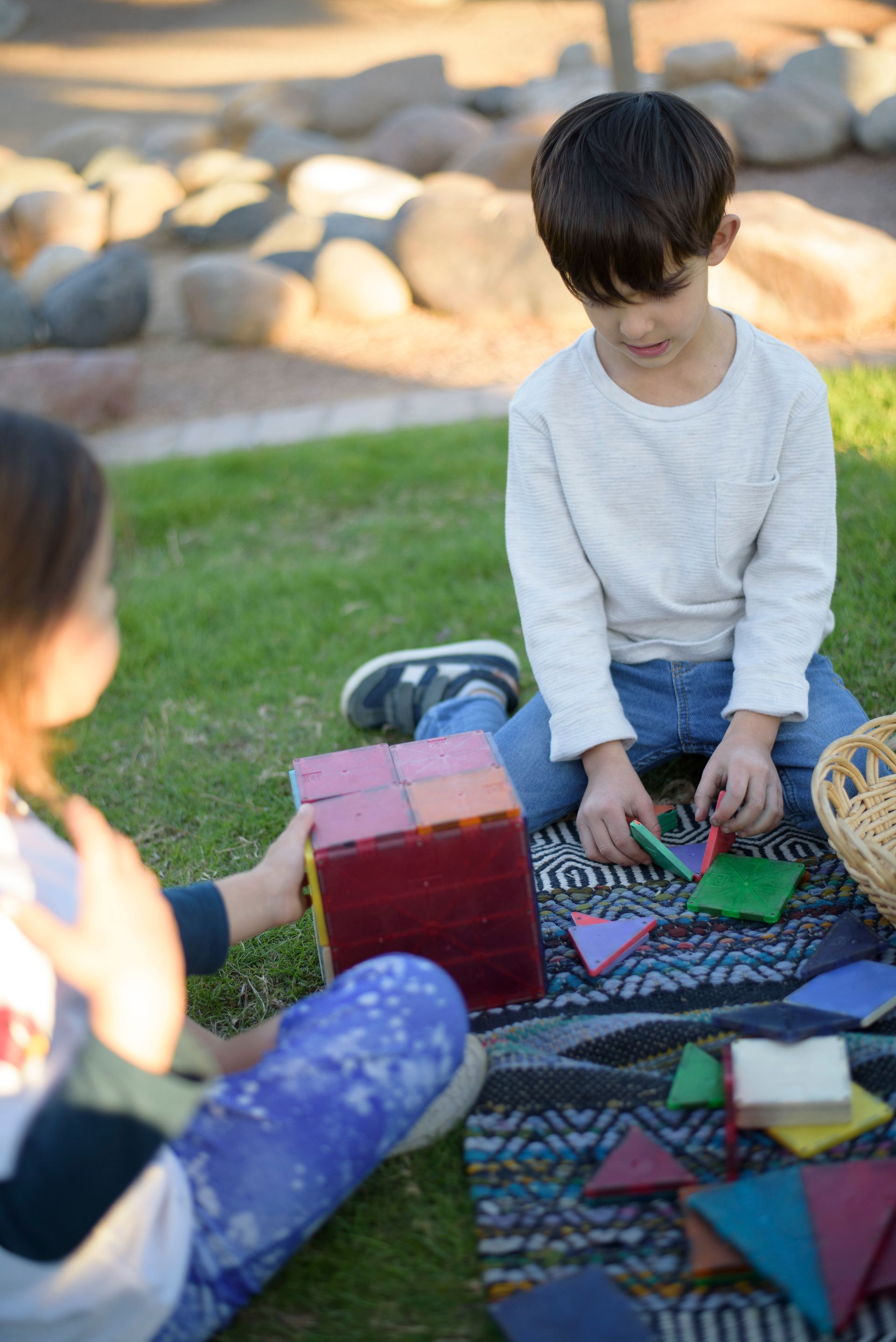
    By having children of different ages together in one room, the younger children enter the environment with a variety of older children that serve as models to them. It is often the case that children learn best from one another, and when a 6-year-old watches an 8-year-old work, they quickly understand what is expected and what kind of work lies ahead in their future. As for the older children in the class, they have many opportunities to serve in leadership roles, cultivating skills that are critical as they become independent members of their communities.

    • Skill progression fluidity

    Learning is not linear, for any of us. There are periods of rapid growth, periods of steady progress, and times spent in plateau. This is normal and will vary across subject areas for individual children. This is why we don’t believe it makes sense to deliver a prescribed curriculum to all students at the same time, ultimately leaving some children bored and others struggling. In our classrooms, kids can work and progress at their own rates. These lines are further blurred when we don’t rely on typical grade levels.

    • Strong relationships

    When a child is in a class for three years, it allows the guide to really get to know them not just as a learner, but as a person. Rather than starting from scratch each September, the child-teacher-parent team is already established and can work together on a deeper level and with greater understanding of strengths and goals than they would be able to otherwise.

    • Enhanced social opportunities

    Diversity is important on all levels, and that includes spending time with people of different ages. We have so much to learn from each other, and children gain all sorts of skills from their interactions in a mixed-age classroom, like empathy, patience, and open-mindedness.

    • Reflection of real life

    We would be hard-pressed to find an example outside of conventional schools in which people are sorted into one-year age groups where they spend most of their day. Multi-age classrooms are a much better approximation of what life is really like, and we think children benefit from these early experiences.

    What did Dr. Montessori have to say about it?

    Maria Montessori had a way with words. While she was a woman of science who relied heavily on her observations, her descriptions and explanations often captured the heart of her audience. Her discussion of the multi-age classroom was no different.

    “Our schools have shown how children of different ages help one another. The younger ones watch what the older ones are doing and ask all kinds of questions, and the older ones explain. This is really useful teaching, for the way that a five year old interprets and explains things is so much nearer than ours to the mind of a child of three that the little one learns easily, whereas we would scarcely be able to get through to him. There is harmony and communication between them that is not possible between an adult and such a young child. There is a natural mental osmosis between them. A child of three is also quite capable of taking an interest in the work of a five year old, because in fact the difference in their abilities is not that great.

    People are concerned about whether a child of five who is always helping other children will make sufficient progress himself. But, firstly, he doesn’t spend his whole time teaching, but has his own freedom and knows how to use it. Secondly, teaching really allows him to consolidate and strengthen his own knowledge, which he must analyse and use anew each time, so that he comes to see everything with greater clarity. The older child also gains from this exchange.”

    How we break it down

    Obviously, a Montessori school doesn’t place a 3-year-old in the same classroom as a twelve-year-old (although we do love to find opportunities for children to work together from different periods of growth and development). Generally speaking, the classrooms take on three-year age spans that roughly correspond with the planes of development.

    • Primary/Children’s House – We combine what would be called preschool and kindergarten elsewhere, with children ages 3-6 working alongside one another.
    • Elementary – We have both lower (ages 6-9) and upper (9-12) elementary environments.
    • Adolescent – Our Adolescent program offers 7 th and 8 th graders opportunities to work together, socialize together, and cultivate leadership and life skills together.

    Still have questions? Email us at [email protected]. We would love to chat with you about how Montessori serves children in a wide variety of ways.


    You might also like

    Teacher guiding children working together at table in Montessori classroom
    May 11, 2026
    See how Montessori timelines make abstract time tangible for children, building historical thinking, imagination, and inner order through hands-on work.
    Child exploring outdoor Montessori environment with hands-on activity
    May 4, 2026
    Discover how Montessori education nurtures children's deepest human needs — from exploration and meaningful work to belonging and spiritual growth.
    April 27, 2026
    In Part One of this series, we began exploring the eight Montessori principles that Dr. Angeline Stoll Lillard examines in her landmark book, Montessori: The Science Behind the Genius . As we saw, what makes these principles so compelling is that Dr. Maria Montessori's intuitions about children were a precursor to what decades of developmental science have since confirmed about how humans actually learn. In this second and final installment, we pick up where we left off, examining the remaining principles and the research that brings them to life. Whether you're a parent, an educator, or simply someone curious about what effective learning really looks like, these insights offer a fascinating window into the remarkable alignment between one woman's careful observations over a century ago and the science we have today. If you haven’t already, be sure to check out the previous four principles: Movement and Learning Are Deeply Entwined Choice Improves Both Learning and Well-Being Children Learn Best When They're Genuinely Interested Rewards Undermine the Motivation They're Meant to Build PRINCIPLE FIVE: Children Learn Powerfully from Each Other When you walk into a Montessori classroom, you’ll notice that children are almost always working near or directly with other children. Peer learning is one of the most effective forms of learning, and Montessori classrooms are deliberately structured to make it a constant. Much of this learning happens through observation. When a child watches a slightly older classmate work through challenging material, they're absorbing the technique and the possibility. They begin to see what they can do! Peer observation often drives a spontaneous "explosion" of writing or number awareness, spreading through a class (e.g., one child suddenly writing everywhere, then several more following). The mixed-age grouping in Montessori classrooms amplifies this. Younger children always have a visible horizon of what's coming next. Older children consolidate their own understanding by helping younger ones (which is one of the most effective learning strategies known). And the large, stable class community means children have time to build genuine relationships and observe one another across many contexts over several years. PRINCIPLE SIX: Meaningful Context Makes Learning Richer and More Lasting Children remember far more when what they're learning is connected to something real and purposeful. What the Research Shows In one study, three-year-olds were asked to memorize lists of items. When the lists were presented as shopping lists for a pretend store, the children remembered twice as many items as those who were simply told to memorize a list. Montessori education is built on this principle. Practical life activities such as cooking, cleaning, caring for plants and animals teach children that the skills they are learning connect to the real world. The Montessori curriculum is deliberately integrated. Vocabulary develops alongside sensorial exploration. Math concepts are entwined with concrete materials that make abstract ideas visible. Knowledge in one area consistently links to knowledge in others. This is why Montessori materials are not isolated exercises but part of a spiral curriculum that returns to the same ideas with greater depth and complexity as children grow. PRINCIPLE SEVEN: How Adults Interact with Children Shapes Everything The way an adult responds to a child's efforts has effects that ripple far beyond the moment. What the Research Shows Carol Dweck's research, now widely cited, demonstrated that a single sentence of feedback can set children on divergent trajectories. Children told "you must be smart" after succeeding at a problem later chose easier tasks, enjoyed them less, and performed worse after encountering difficulty. Children told "you must have worked hard" sought harder challenges, recovered from failure more readily, and improved their performance over time. The difference is in the delivery of one sentence! The implications are profound for how we talk to children about both their successes and their struggles. In a Montessori classroom, the adult’s role is carefully defined: to observe, to connect children to materials at the right moment, to step back when a child is productively engaged, and to step in only when something is genuinely unproductive or unsafe. This requires a great deal of precision and restraint. An adult who constantly intervenes, corrects, and directs trains children to look outward for approval. An adult who observes and offers at the right moment helps children learn to look inward. Consistency and long-term relationships also matter. The multi-age grouping in Montessori means that children spend multiple years with the same adults, building the kind of attachment and trust that research consistently links to stronger learning outcomes and healthier social-emotional development. PRINCIPLE EIGHT: Order in the Environment Supports Order in the Mind The Montessori classroom's distinctive aesthetic reflects a deep understanding of how the environment shapes cognition. What the Research Shows Research consistently shows that noise, clutter, and unpredictability are cognitively costly for children. When an environment is chaotic, children spend precious mental energy managing uncertainty rather than engaging in learning. Temporal order matters as much as spatial order. The three-hour uninterrupted work cycle (a hallmark of Montessori classrooms) gives children long enough stretches of focused time to move from initial engagement to deep concentration and, eventually, to the kind of absorbed flow that produces real intellectual development. Frequent interruptions (bells, transitions, whole-class pivots) train children to work in short bursts and to constantly reorient. The three-hour cycle allows children to go deep. Children in Montessori classrooms are also responsible for maintaining their environment by returning materials to their proper place, caring for plants and classroom spaces, and treating everything with consideration. This care builds the child's relationship to order as something they participate in creating rather than something imposed from the outside. Even noise levels matter in ways that go beyond comfort. What the Research Shows Research cited by Dr. Lillard found that across all ages, noise was one of the most consistently negative influences on cognitive development, partly because it interferes with the auditory discrimination that underpins both reading and vocabulary development. The quiet that characterizes a well-functioning Montessori classroom is the natural result of many children deeply absorbed in their own work. What makes Dr. Lillard’s work so valuable because it validates the Montessori method and gives the why behind practices that can otherwise seem puzzling from the outside. There are important reasons why Montessori teachers don't correct every error, why there are no gold stars, why the classroom is so quiet, and why children seem to do the same work over and over. This approach to education is deeply rooted in creating conditions in which children's natural drive to learn can develop as fully as possible! To learn more, visit our school here in Milwaukee. And let us know if you would like to borrow a copy of Montessori: The Science Behind the Genius by Dr. Angeline Stoll Lillard! It is one of the most research-grounded books available on Montessori education, and we highly recommend it for anyone who wants to understand the deeper logic of Montessori!
    More Posts