More Than a Meal: How Food Nurtures Growth, Independence, and Connection
Throughout history, human survival has depended upon finding, preparing, and sharing food. It is easy to see why food holds such a central place in our daily lives, our families, and our cultures!
In our classrooms at North Shore Montessori School, we recognize that food plays an extraordinary role in a child’s holistic development. While healthy nutrition is always essential, food represents so much more. Through food preparation and shared meals, children develop a richer understanding of the world, master real-world independence, build expressive language skills, and experience meaningful cultural connections.
Exploring the World Sensorially
During early childhood, children experience a natural sensitive period for refining their senses. To truly understand food, young children need opportunities to experience it in its natural state rather than solely through prepackaged snacks.
In our Primary and Lower Elementary environments, we offer children sensory-rich experiences with fresh, whole ingredients:
- Sensory Exploration: Children touch, smell, taste, and observe raw ingredients as they transform through washing, chopping, and cooking.
- Connecting to Nature's Cycles: Whenever possible, children observe fruits, vegetables, and herbs growing in our outdoor spaces or planters, learning about seasonal harvesting and the parts of plants we eat—leaves, stems, roots, seeds, and flowers.
- Understanding the Whole Process: Rather than opening a package, children help make homemade breads, fresh applesauce, or vegetable soups from scratch, experiencing every step of the journey.
As children grow into our Elementary program, their connection to food expands into production, budgeting, and community service—such as planning recipes, purchasing ingredients, and preparing whole meals to share with others.
Mastering Independence and Fine Motor Skills
Food preparation is one of the most beloved areas of Practical Life in a Montessori classroom. It offers purposeful work that refines physical coordination and builds genuine self-reliance.
Building Progressive Skills
We introduce food preparation through clear, sequential steps:
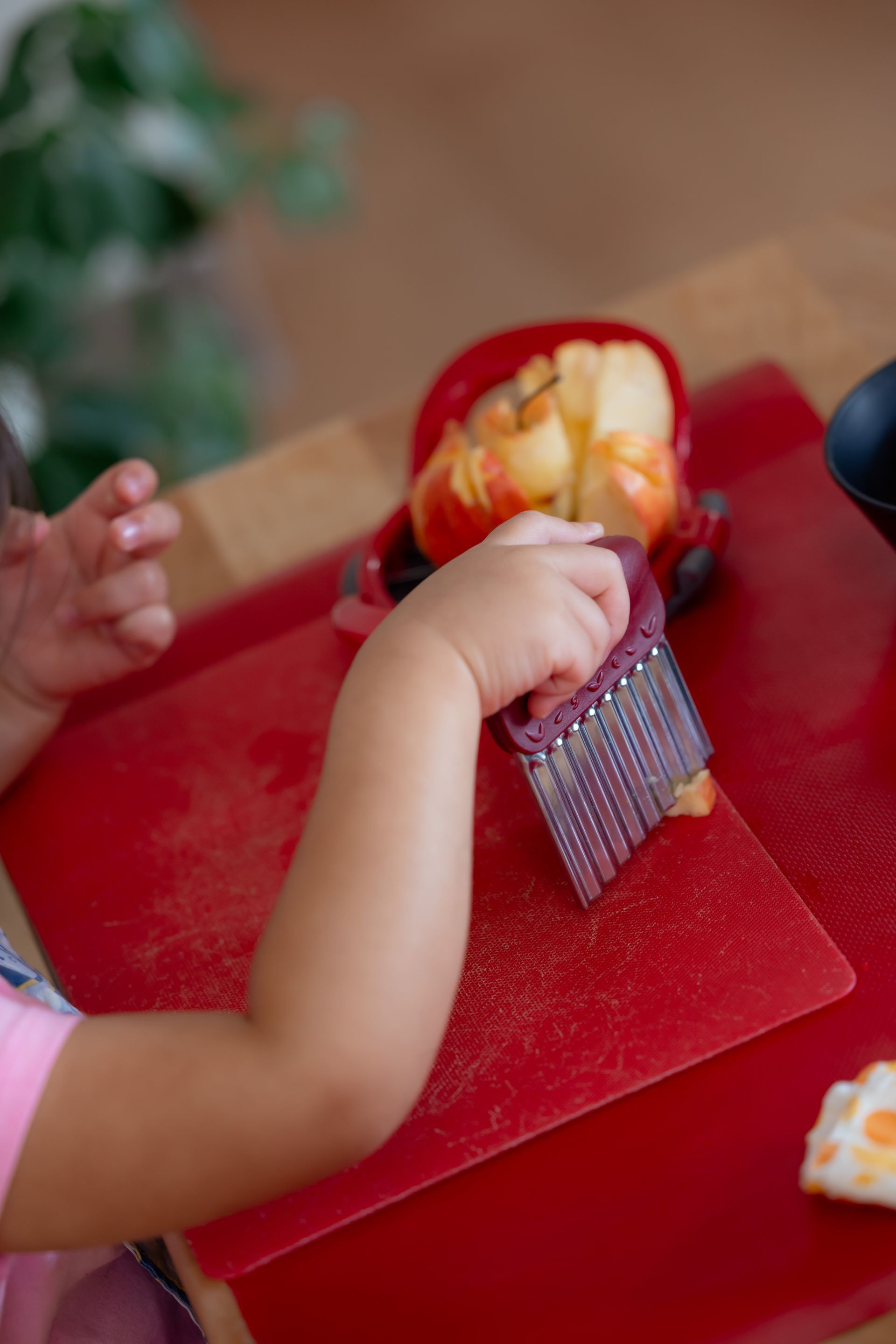
- Initial Skills: Washing produce, peeling bananas, spreading butter, juicing citrus, and slicing soft fruits with child-safe tools.
- Advanced Motor Control: Using a hand grater, holding and controlling a kitchen knife, or using an apple slicer.
- Complex Processes: Following multi-step written recipes and safely operating classroom kitchen tools like toasters, blenders, or hand mixers.
Child-Sized, Functional Tools
For children to master movement, their tools must fit their hands. We provide real, functional, child-sized kitchen utensils—small pitchers that fit little hands, mini cutting boards, and light-touch slicers. Through meaningful repetition, children refine their hand-eye coordination and build immense confidence in their own abilities.
Expanding Language and Mathematical Thinking
Food preparation naturally enriches a child’s vocabulary and introduces abstract concepts through concrete experience.
- Precise Terminology: Guides carefully name specific ingredients, tools, and actions—such as zest, dice, whisk, colander, or clove—fixing these words permanently in the child’s memory.
- Indirect Prep for Mathematics: Setting the table offers authentic practice with one-to-one correspondence and counting. When a child sets out four plates for four friends at a table, they lay the physical foundation for future math concepts.
- Spatial and Grammatical Awareness: Setting a table serves as an indirect lesson in prepositions. As a child naturally places a fork to the left of the plate or a napkin underneath the spoon, they experience spatial language in a meaningful context.
- Reading and Creative Writing: Older children practice reading comprehension by interpreting multi-step recipes, writing their own instructional steps, and composing creative menu descriptions.
Celebrating Culture and Community
Food is deeply tied to human culture, family traditions, and social grace. Across the globe, people gather around food to celebrate, share customs, and nourish one another.
Bringing family recipes, cultural dishes, and traditional preparation methods into our classroom communities creates a rich, culturally responsive environment. It allows every child to feel a sense of pride in their heritage while expanding their appreciation for the diverse world around them.
Experience Practical Life in Action
Food preparation is an essential part of our daily rhythm at North Shore Montessori School, turning everyday routines into moments of joy, focus, and independence.
We warmly invite you to visit our school to observe our Practical Life areas in action—and perhaps even share a favorite family recipe or culinary tradition with our classroom community!
Schedule a school tour and learn more about our child-centered programs.
You might also like